One view of service across your hotel’s food and beverage outlets
Postree Blog · Hotel Operations · September 2026
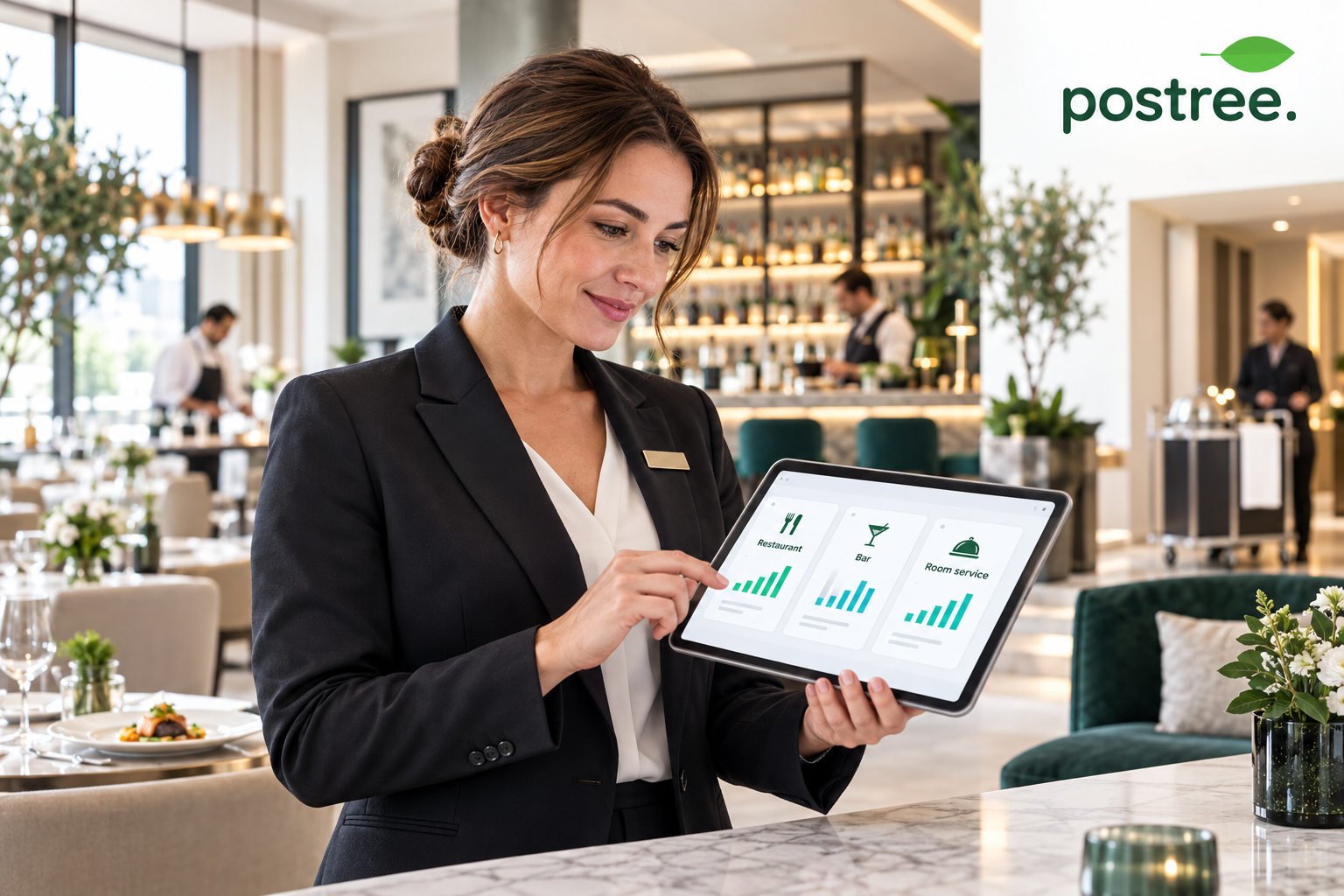
A hotel’s food and beverage operation often behaves like several businesses under one roof. Breakfast, the restaurant, the lounge and room service have different trading patterns, but managers still need a useful overall picture.
Postree’s hotel offering brings these outlets into a connected POS environment, with central reporting, outlet-level views and staff access controls. The objective is consistency where it helps, without losing the distinctions that make each outlet manageable.
The use case: a hotel moving from breakfast to evening service
Imagine a hotel where staff move from breakfast into lounge service, while the restaurant prepares for dinner. Different systems or reporting formats can make those transitions awkward. A manager may spend the evening collecting figures instead of understanding which outlet needs attention.
A shared platform can give staff a more familiar ordering process and managers a central view. Outlet reporting remains important: combining totals should not hide whether sales came from the restaurant, bar or room service.
The solution: define each outlet before connecting it
Agree how orders, products and staff roles are assigned. Decide which menus and prices should be shared and which need to stay specific to an outlet. Set permissions so staff have the access required for their work.
Postree’s hotel page describes multi-outlet management, room-charge support and centralised reporting. Room charging should be demonstrated with the property-management system and payment setup your hotel actually uses. Do not assume that a general integration description establishes compatibility with every hotel system.
For preparation, consider how each outlet’s orders reach the kitchen. A KDS may help make outstanding work visible, while a handheld OrderPad can support staff serving a lounge or terrace away from a fixed till.
Where the efficiency comes from
A more consistent interface can reduce the friction when staff move between outlets. Central reporting can reduce the work of gathering separate summaries, while outlet-level records help managers investigate a particular service rather than relying on a hotel-wide total.
Reservations can support the restaurant’s arrival planning. Staff time tracking can make shifts easier to review, and catering workflows may be useful for functions where that service is configured. These tools should support a clearly agreed operational process rather than become disconnected additions.
Test a complete hotel journey
Choose a realistic scenario for the demonstration: a guest places an order, the correct outlet and kitchen receive it, the appropriate payment or room-charge route is used, and the transaction appears in the expected report.
Measure reconciliation time, correction rates and the effort required to train a colleague moving between outlets. Compare similar services and keep exceptions visible.
Ask Postree to review your outlet structure, existing systems and reporting needs together. A connected setup is most useful when the detail of each outlet remains clear.