One connected POS: a busy service without the double entry
Postree Blog · Restaurant Operations · September 2026
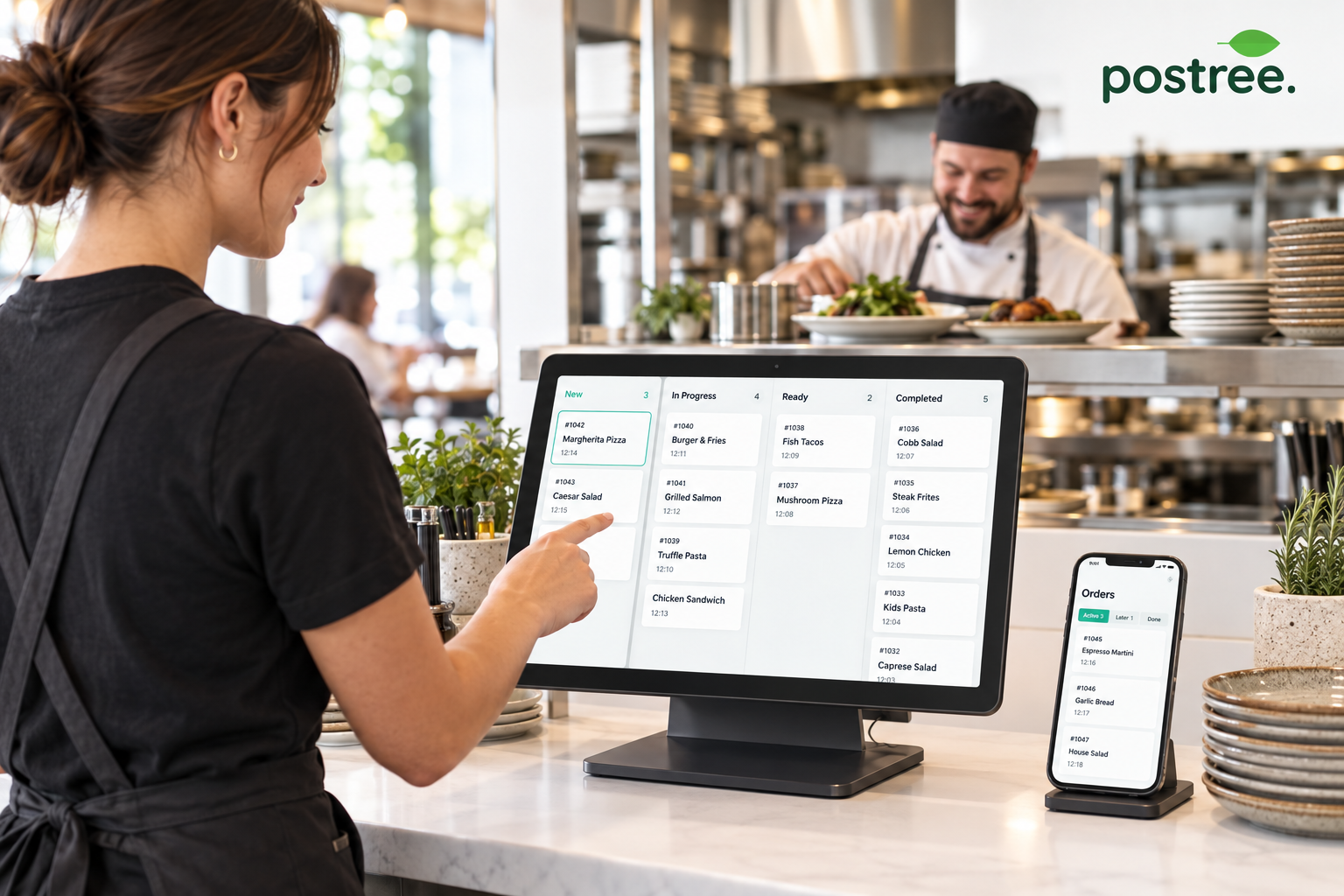
A busy restaurant rarely handles one type of order at a time. A table asks for another round, a customer arrives for collection and an online order lands while the cashier is taking payment. The difficulty is often the handover between these activities, rather than any single task.
A connected POS gives those orders a common place to go. Postree brings in-person orders, direct online ordering and supported integrations into the same operational workflow, alongside tools for bookings, vouchers and reporting.
The use case: a restaurant serving three channels
Consider an illustrative neighbourhood restaurant offering dine-in meals, takeaway collection and delivery. Before service, the team checks separate screens and a booking diary. During service, a colleague copies web orders into the till so the kitchen can prepare them. Every copied order creates another opportunity for a missed item or incorrect quantity.
With Postree, orders from the restaurant’s Postree website and app arrive at the POS. Staff enter table and counter orders through the same system, while connected delivery integrations can feed their orders into that workflow too. The team still checks order details, but it does not need to recreate each order from scratch.
The solution: connect the handovers
Start with the routes an order follows. Decide how dine-in, collection and delivery are identified, who checks new orders and how the kitchen receives them. Add OrderPads where staff need to take orders away from the counter, and a Kitchen Display System where a shared preparation board would help.
Reservations and gift vouchers can also connect with the POS. This makes the arrival and payment stages easier to follow, rather than treating them as unrelated administrative jobs.
Where the efficiency comes from
The practical gain is fewer repeated steps: less retyping, less switching between devices and fewer conversations needed simply to establish which order belongs to which channel. A clear order record also helps when a customer asks about an item or payment.
For a café, the same approach can connect counter sales with advance collection. For a bar, it can support orders taken away from the main till. The workflow should fit the venue, rather than forcing every business into the same service pattern.
Measure the change in your own venue
Before changing systems, record how often an order is entered twice, how many corrections are needed and how long the end-of-day review takes. Compare similar trading periods after staff have settled into the new process.
Postree supports continued POS order-taking during an internet interruption, with saved activity syncing after reconnection. Confirm the separate connectivity requirements for card payments, online channels and other connected services during setup.
Ask for a Postree demonstration using a real service scenario from your venue: a table order, a collection and a payment handled together.